Hospitality & Abundance, Part 6

In the Ancient Near East the practice of hospitality moved beyond relational embrace to holistic care. It was a moral commitment that involved compassionate care and generosity for the “other,” especially someone far from home. Food, shelter, and physical well-being are signs (and outcomes) of hospitality. With this in mind I like to think of hospitality as solidarity with neighbors, including strangers, expressed by a mutual relationship of faithful presence, compassion, and generosity where we come together in the struggle for dignity and human flourishing.

Back to Jesus. With the inbreaking of God’s kingdom a new way of understanding what it means to be human has been announced. With God as Provider there is no limitation of resources. With God as divine Homemaker anyone can find a home. But this conviction must be enacted and practiced among those who confess it.

So Jesus mandates his followers to, “Love your enemies! Do good to them. Lend to them without expecting to be repaid. Then your reward from heaven will be very great, and you will truly be acting as children of the Most High, for he is kind to those who are unthankful and wicked. You must be compassionate, just as your Father is compassionate.” Luke‬ ‭6‬:‭35‬-‭36‬ ‭NLT‬‬

About this text Dr. John Koenig observes, “the underlying faith expressed is that God takes an active part in generous relationships between humans, more than covering any “losses” incurred by the one who extends aid. But those who choose the life of greedy accumulation over the life of sharing cut themselves off from God’s abundance.” (New Testament Hospitality: Partnership with Strangers as Promise and Mission, 37.)

What followers of Jesus have to decide is do we believe God can cover any potential “loss”, and then some, when we take this kind of hospitality serious enough that we become reliant on God’s abundance?


Posted in Uncategorized | Leave a comment

Hospitality & God’s Abundance, Part 5

Thinking of Jesus’ closest followers they would have been hard to describe as a community. The social descriptions available to first-century Palestine didn’t have a clear category for them. They were not only the destitute or only the rich, among them were both. They were not only male or only female, among them were both. They were not only the out-crowd or only the in-crowd, among them were both. We read of the inclusion of the working class and the upper class (Mk. 1:16-20; John 19:38); of a military leader and a synagogue ruler (Mt. 8:5-13, Lk. 7:1-10; Mk. 5:21-24, 35-43); of the religious and political elite to the religiously and politically left-out (Lk. 8:1-3; 19:7; Mk. 15:42-43; Jn. 19:39).

God’s hospitality and abundance at work among them created a common life between them that opened up new possibilities. You see this in the system of economics at work in the community of Jesus. It appears as nonsensical as it does paradoxical. Although the larger community of followers consisted of a variety of social descriptions and classes, it all began with the twelve disciples. They walked away from economic security in the form of jobs and ready-accessible possessions to discover the way of God’s abundance in the form of material hospitality.

Posted in Uncategorized | Leave a comment

Hospitality & God’s Abundance, Part 4

Jesus spoke liberation to the “ptochos,” neighbors pressed down by poverty systems. (Lk. 6:20-23; 12:22-34). Jesus often brought attention to them when talking with others (Mk. 10:21; 12:41-44; Lk. 14:13-14; 16:19-31). His relentless commitment to extending God’s hospitality to them and others labeled “sinners” was controversial and outside of the social, political, and religious norms. In part it’s why Jesus stayed in trouble (Lk. 7:31-34).

There are moments when it seems his disciples struggled to catch the vision of how God’s abundance opens up God’s hospitality. Their desire for group-identity and social connections based upon commonalities revealed a kind of exclusionary posture within them. You see it when they wanted to keep children away from bothering Jesus (Mk. 10:13-16) or when they side-eye’d the guy casting out demons in Jesus’ name but was not a part of their local group (Mk. 9:38-41; Lk. 9:49-50). You see it in the shock they felt as they saw Jesus talking to a Samaritan woman at a well (Jn. 4:27) or how they wrestled with the boundaries and limits of forgiveness (Mt. 18:21-22). Each time you hear Jesus’ response you catch a common theme: trust God’s abundance, see how freely God welcomes you into the Kingdom, and extend that same welcome to others (Mk. 9:40; 10:15; Jn. 4:34-38; Mt. 18:22). And if he offered these responses in public, which it seems he did for at least three of them, those within ear shot would know that no one is beyond the reach of God’s provision and welcome.

Jesus’ teaching on loving enemies, what could be seen as the most subversive expression of God’s hospitality and abundance, makes this particularly clear. As my mentor and friend Dr. Arthur Sutherland has written, “This gladness takes us to the heart of christian hospitality: I see the stranger, even the armed and threatening enemy, and because I know that Christ has died and been raised for both of us, the final and ultimate seriousness of their threat is taken away.” (I Was A Stranger: A Christian Theology of Hospitality, 38.)

I bet his followers and hearers liked this teaching on loving enemies about as much as many do today. Nothing pokes at false allegiances to nation-states than the summons to love enemies rather than kill them.

Posted in Christian living, Church, Theology | Leave a comment

Hospitality & God’s Abundance, Pt. 3


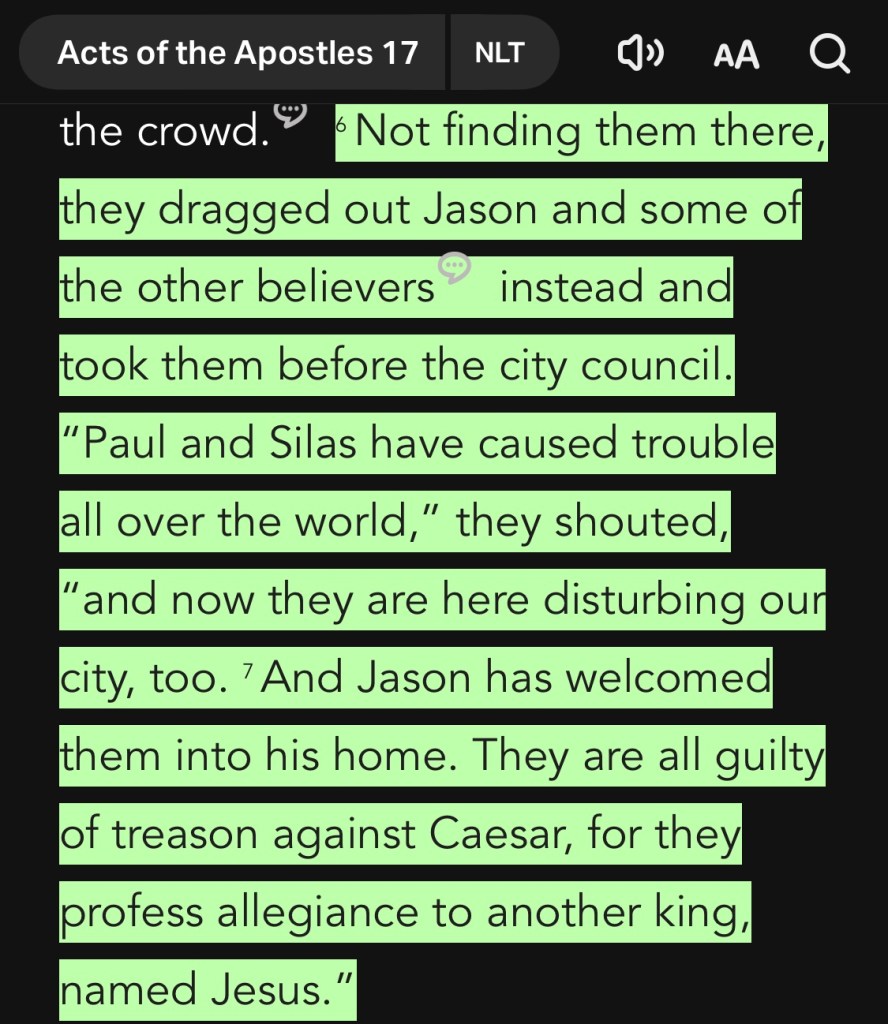
What else can be observed when considering the images Jesus associates with God’s hospitality and abundance is that the Church cannot become a living parable or a “sign, instrument, and foretaste” of Christ’s reign if we are seduced to other “reigns,” that is to say, allegiances, particularly to a nation. Not only does the testimony of the Church throughout Acts bear witness—it was said they were “guilty of treason against Caesar, for they profess allegiance to another king, named Jesus” (17:7)—but it amounts to an absurd pursuit of smaller kingdoms where the Church becomes the main character in a comedy of errors. When contrasted with the testimony of Jesus and his followers it should be clear to us how dangerously misguided, exclusionary in practice, unjust in ethic, and shortsighted in vision this kind of pursuit becomes. When we lack faith in God’s abundance and waiver in commitment to God’s inclusionary hospitality we experience a subtle shift from allegiance to Christ’s reign alone to Christ’s reign plus another.

This is the current reality of American life. There is no longer a “christianity,” but “christainities” (I believe this has always been true). We must be mindful as to which expression looks most like the Jesus of Scripture.

Posted in Uncategorized | Leave a comment

Hospitality & God’s Abundance, Pt. 2

The numerous images of God’s kingdom associated with God’s abundance and hospitality that Jesus used leads me to believe that Jesus and his followers were to be a kind of living parable of how people live together from God’s abundance. As one scholar and missionary (Lesslie Newbigin) said, “the church lives in the midst of history as a sign, instrument and foretaste of the reign of God.”

The Christ-followers’ response to the gospel in Acts 2 and the “common life” they cultivated lends credibility to this parable-like way of life.

Posted in Church, Social Justice, Uncategorized | Leave a comment