Resurrection in a World of Contradictions

This Easter we look around and see a world of contradictions.
While one person experiences great joy, another mourns great loss.
While one person is overcome with laughter, another is overcome with tears.
While one person is filled with peace, another is filled with anger.
While one person experiences love, another experiences hate.
While one person recovers from this virus, another doesn’t.

The contradictions are real, maybe now more than ever. We have been told for several days that on Easter Sunday our nation will reach its peak for the virus. We have been told that this week and the next could result in a loss of life as great as 9/11. In New York it did. We are told that on Easter Sunday we will run reach the height of shortages in medical resources and beds, leaving many neighbors without a safe place to heal or very literally, breathe. 

The tyranny of the reign of sin and death is intersecting with the most holy of days in the Christian calendar in a way that reminds us of the depth of contradiction we feel. We grieve global and national loss while celebrating a different kind of life-redefining victory. We worry over our health while we worship our risen King. We know that throughout this world and our nation, our brothers and sisters in Christ are overcome by this virus and the terror it brings, while at the same time remembering that Resurrection Day will not be overcome. Death has been overcome by the empty tomb.

In all of this there is a strange paradox, a contradiction in what we see when we look back on the Cross of Friday from the Resurrection on Sunday. In Christ’s resurrection His woundedness becomes our healing, his ruin becomes our redemption, his loss becomes our gain, and his tragedy becomes our triumph. 

The resurrection tells us that darkness will turn to light, pain will turn to peace, brokenness will turn to beauty, and death will open up to resurrection life.

Death cannot take away life anymore because new life has already been given through death.

Christ’s first resurrected breath frees us from the chains of death.

Posted in Uncategorized | Leave a comment

Holy Week: Tears and New Life, Pt. 2

A day or so later Jesus is with his disciples. John actually picks up this part of the story in his retelling of the gospel. In John chapter 12 Jesus tells his disciples:

“The hour has come for the Son of Man to be glorified. “I assure you: Unless a grain of wheat falls to the ground and dies, it remains by itself. But if it dies, it produces a large crop. The one who loves his life will lose it, and the one who hates his life in this world will keep it for eternal life. If anyone serves Me, he must follow Me. Where I am, there My servant also will be…”

John 12:23-25

Jesus knew what many of us sometimes forget but remember each Holy Week: the path to resurrection is always preceded by a kind of death. 

Many of us want new life, a new start, a new beginning; resurrection. But if we are to experience resurrection we must be willing to embrace a kind of death.

The dying Jesus talks about can be understood as a kind of letting-go. It is a letting-go of the things in which we have placed too much confidence or allowed to hold our hope.

Right now we have all been pushed into a kind of letting-go. We are letting go of a life we have known so we can hold on to life. We are letting go of face-to-face connections, of eye contact, of hugs from friends or family members we do not live with us, of nights out or meals at our favorite restaurants. We are letting go of gathering together in person to praise God and share in the Table. Over the past weeks we have even  heard stories of loved ones letting go of family members as they are carried away to a private room, some for the last time.

We know about letting-go maybe now more than ever. We see signs of it all around us. But there are signs of letting-go that are life-giving and, I think, look a lot like the kind of letting-go Christ calls us to embrace.

It’s the nurses, doctors, and medical staff, the mental health professionals and hosts of other medical professionals letting-go of their own well-being to tend to the well-being of others. And it’s the scenes of these same people standing on the roof tops of hospitals with hands held high or heads bowed for to pray for their patients and for their city.

It’s the scientists and medicine makers, and leaders of other agencies letting-go of time with their families in exchange for long hours as they work hard to understand this virus that has arrested us and find an antidote.

It’s the cleaning crews in medical facilities, the grocery store workers, postal workers, bus drivers, truck drivers and delivery persons, it’s the social services case workers and non-profit leaders letting-go of their own needs to make sure our needs are met.

It’s the teachers and educators letting-go of their traditional lesson planning to find new ways to educate children from one side of a screen while still taking time to parade through neighborhoods to cheer on their students or call and check in with parents to see how every one is doing. 

It’s the police and firefighters, paramedics, and caregivers of every kind letting-go of their own safety, and even the safety of our their families, so we can be safe.

It is in letting-go that we pick up what Jesus offers. It is in letting-go that we take hold of what gives life, purpose, and meaning. It is in letting-go of the things in which we have placed our confidence that we can place our confidence in Jesus as King.

Posted in Uncategorized | 1 Comment

Holy Week: Tears and New Life, Pt. 1

The Mount of Olives has a history with tears. The Hebrew Scriptures tell us that King David climbed the Mount of Olives to grieve his son Absalom after he learned Absalom was leading a conspiracy to overthrow him.

As Jesus made his way to the Mount of Olives he would weep, too.

As He approached the Mount of Olives and saw the city, He wept over it, saying, “If you knew this day what would bring peace—but now it is hidden from your eyes. For the days will come on you when your enemies will build an embankment against you, surround you, and hem you in on every side. They will crush you and your children within you to the ground, and they will not leave one stone on another in you, because you did not recognize the time of your visitation.

Luke 19:40-43

For thousands of years Jerusalem has executed prophet after prophet. They did not prefer the message of God’s reign of love and peace. They preferred nationalistic pride and greed. In the end all that was left were the tears of the prophets.

Now it’s Jesus’ turn to weep. Earlier in Jesus’ ministry we find many stories of tears. The widow at Nain weeps over her dead son. Jairus’ family weeps over a dying daughter. We find others in distress coming to Jesus for healing and new life. In each story Jesus meets them in their tears.

Beloved, Jesus will always meet us in our tears because our tears flow from all that is wrong with God’s good world. It is why we see Jesus in tears over the city of God’s people. I think it is easy to forget that Jesus’ tears are at the center of the Christian story.

Jesus weeping over the city was not a moment of regrettable weakness or fear. It was a moment of love, of vulnerability and heartache, because of what he knows what will happen to God’s people. Again and again during his ministry Jesus warns them, summoning them to God’s reign of love and peace. Like many of the towns Jesus visited along Galilee, they resisted.

“Unless you turn away from building your own little kingdoms and turn toward God’s kingdom,” Jesus would say, “you will perish.”

Here Jesus is, face to face with the city where Pilate had killed many Galileans, and would soon kill one more. Here he is about to face two different trials from two different powers: a religious trial led by Ciaphas and a political trial led by Pilate. Two powers–religion and politics–all promoting the same vices, fear-mongering, power-grabbing, and death.

We know from the gospel stories that where the Temple was once a holy place it was now a symbol of nationalistic pride and religious greed. The systems of religion and politics in Jesus’ day led his people far away from the love and peace God wanted them to experience.

No wonder Jesus weeps. No wonder Jesus must enter into the Temple and cleanse it of its pride and greed. No wonder Jesus must walk through a week of sorrow and suffering, a week like no other, a week set apart for all eternity, a Holy Week.

During Holy Week we must not forget Jesus’ tears.

During Holy Week we must not forget Jesus’ scandalous trials and cruel death.

During Holy Week we must not forget Jesus’ passion.

During Holy Week we must not forget Jesus was doing all of this for us so we could be rescued from captivity to fear and the death-dealing wounds of the reign of sin and death.

And during Holy Week we must not forget that if there is to be resurrection, there must be death, a particular kind of death for Jesus, and a particular kind of “death” for us.

Carlton is a wonderful young man and student at the College of William & Mary. He was inspired by our church’s Palm Sunday gathering and wrote this stirring poem.
Posted in Uncategorized | Leave a comment

Holy Week & Public Displays of Freedom

Zechariah’s prophecy (9:9-10) announces the righteous and victorious King of Israel will come, not on a war horse like other kings, but on a donkey in humility and peace, bearing witness to a different kind of kingdom.

In the Christian tradition we understand that when Jesus enacts the promise he is performing an unmistakable political act on behalf of a new kind of liberation. It’s why Matthew tells us in his retelling of the event that it has thrown the whole city in turmoil as people were asking, “Who is this?” (21:10-11)

Acting on behalf of a new kind of freedom that threatens the principalities and powers that dictate the terms of freedom, and to do so in such a public way, is a dangerous thing.

We know this to be true.

On the day before Palm Sunday we remembered the assassination of Dr. Martin Luther King. We remember that the more public his declaration of freedom became, the more of a threat he grew, and the more his enemy pursued him, resulting in his death on a balcony at the Lorraine Motel in Memphis.

In remembering Dr. King we remember Medgar Evans. We remember that the more public he made his fight for freedom from Jim Crow in Mississippi, the more his enemy pursued him, resulting in his death in his driveway.

We remember the Freedom Riders of 1961, groups of white and African American activists whose declaration of freedom put on public display in the American South led to horrific violence against them.

Going public with a declaration of a new kind of freedom that threatens the principalities and powers that dictate its terms is a dangerous thing. Dr. King knew it. Medgar Evers knew it. The Freedom Riders knew it.

Jesus knew it. He knew the weight of the liberation he would bring, a liberation like no other, and the weight of suffering and violence he would endure because of it. And he did it anyway. For every one.

I’m thankful he did.

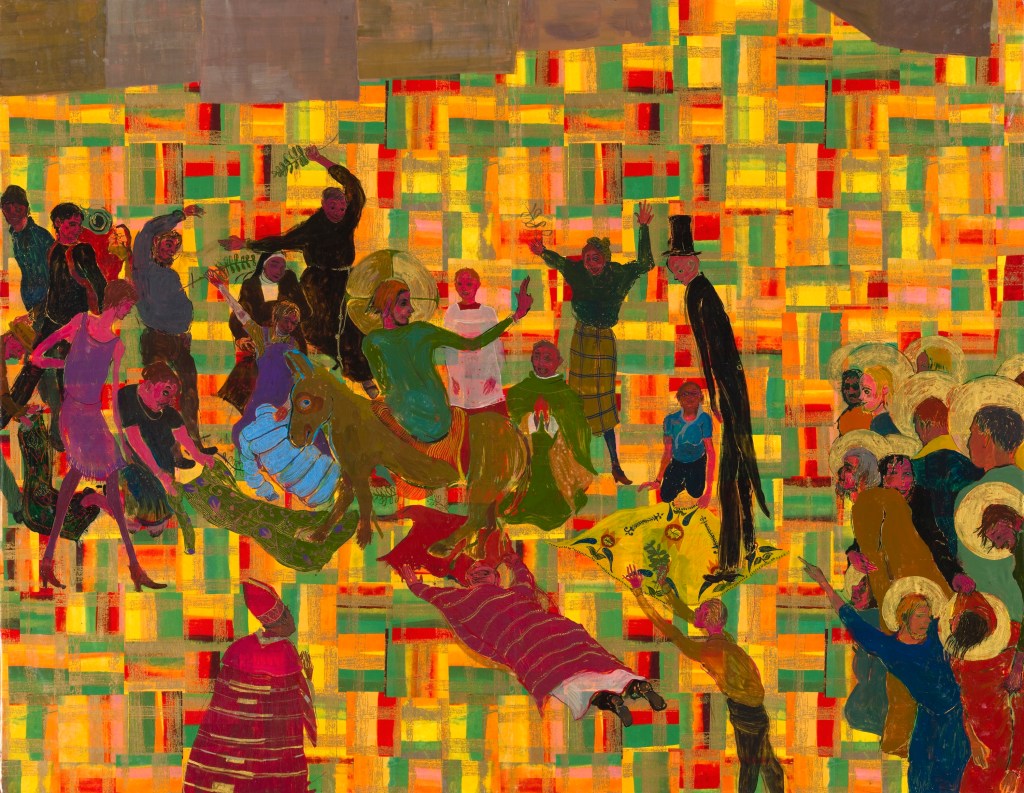
A Palm Sunday Painting by Kai Althoff
Posted in Uncategorized | Leave a comment

Lord, Have Mercy: A Litany of the Person

As I have reflected all around me, and as I have been quite restless at night, I thought it would be fun, and hopefully encouraging, to make a short video (just over 3 minutes). You can watch it here.

I think I’ll try and make one each week.

The link to the poem read in the video is below.

A Litany of the Person

image of God

born of God’s breath

vessel of divine Love

after his likeness

dwelling of God

capacity for the infinite

eternally known

chosen of God

home of the Infinite Majesty

abiding in the Son

called from eternity

life in the Lord

temple of the Holy Spirit

branch of Christ

receptacle of the Most High

wellspring of Living Water

heir of the kingdom

the glory of God

abode of the Trinity.

God sings this litany

eternally in his Word.

This is who you are.

Source: (from the Abbey of Gethsemani)

Posted in Christian living | Leave a comment