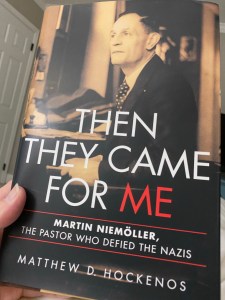
What Martin Niemoller Can Teach Us, Part 1

Last week I began this book by Matthew Hockenos. I have read a little about Martin Niemoller, but nothing of depth. A former German Navy officer turned Christian pastor, Niemoller was a complicated man before and after WWII. For many years he was untroubled by Hitler’s nationalism and persecution of minorities. He agreed with thousands of other pastors that minorities and dissenters were anti-Christian and disloyal to Germany. Looking back he realized that in his younger years he was subtly formed by a cultural system that did not consciously despise Jews, but did so subconsciously. He says, “I had no hatred against Jews but this whole atmosphere of noncooperation with the Jews was just that in which everybody grew up.”⁣ (12)

Take that in. It’s how cultural systems work. It’s how family systems work. It’s how ideology works. Subtle. Implicit. Quiet. Formative. ⁣

As Hitler’s empire grew and much genocide was dealt, Niemoller awakened to Christ in a deeper way and saw through Hitler’s rhetoric. He recognized his own nationalistic antisemitism and took a stand against Hitler’s nationalistic empire, influencing a Christian movement of protest. He was imprisoned. Following the war he felt great regret for his naive racist, anti Semitic, nationalistic disposition. Hockenos writes:⁣

“Dachau has opened in March 1933, when the Nazis began incarcerating their enemies, just one month after Hitler came to power. Niemoller has been a free man at that time, a prominent pastor of an influential parish, and he remained at liberty until his arrest in 1937. Imprisoned in a Berlin jail and a concentration camp from 1937 to 1941, Niemoller and other famous camp inmates were tranferred by the Nazis to Dachau in 1941. ‘My alibi accounted for the years 1937-45,’ he told a German audience a few months after he and his wife visited Davhau. ‘But God was not asking me where I had been from 1937 to 1945 but from 1933 to 1945. . . and for those [earlier] years I did not have an answer.'”⁣ (2)

Niemoller later wrote his confession:

“First they came for the socialists, and I did not speak out—because I was not a socialist.⁣ Then they came for the trade unionists, and I did not speak out— because I was not a trade unionist.⁣ Then they came for the Jews, and I did not speak out—because I was not a Jew.⁣ Then they came for me—and there was no one left to speak for me.”

In the words of my friend Charvalla, “May the past provoke us to examine our present and inspire us to more intentionally contribute to our future.”

I’ll offer a second reflection mid-week.


Posted in Christian living, Church | 2 Comments

Where is She to Go?

Luke tells one of my favorite stories. It’s about woman he identifies as a sinner (some believe her to be a prostitute). She courageously crashes a religious leader’s dinner party to see Jesus. When she does she falls to his feet weeping. In an act of customary hospitality reserved for a house slave she washes his feet, except with her tears. She dries his feet, except her hair. She kisses his feet and anoints them with her expensive perfume. Luke closes the story this way:

Those who were at the table with Him began to say among themselves, “Who is this man who even forgives sins?” And He said to the woman, “Your faith has saved you. Go in peace.” (Luke 7:49-50)

Jesus says to her, “Go in peace.”

But where is she to go?

The price of her coming to Jesus is that she can no longer go back to the way of life that sustains her. The one place she is welcomed, among people like her, is no longer a wise place for her to go.

Where is she to go? And what will she need if she is to get there?

I’m not sure where, but I have an idea of what she will need if she’s to find it.

She will need to be loved by a beloved community. She will need a forgiving community of forgiven sinners. She will need a place of belonging where she can reorient herself toward a life-giving story. She will need a community that refuses to ignore her struggle and is willing to tell the truth in the faces of injustice that glaringly stare her down. She will need a community that will weep when she weeps and rejoices when rejoices. She will need her burdens shared, some help with rent, and a few bags of groceries.

She will need more than good music and messages once a week. She will need more than spiritual pep-rallies. She will need more than programs that fulfill her needs through transactional engagement strategies and volunteerism. She will need more than thoughts and prayers.

What she needs is a community awakened to God’s hospitality that welcomes her as they have been welcomed by Christ. She needs a community of royal priests and hospitable homemakers who have made their home with the God who reigns in Christ.

We need that, too.

We need what she needs.

She is us.

Posted in Christian living, Church | Comments Off on Where is She to Go?

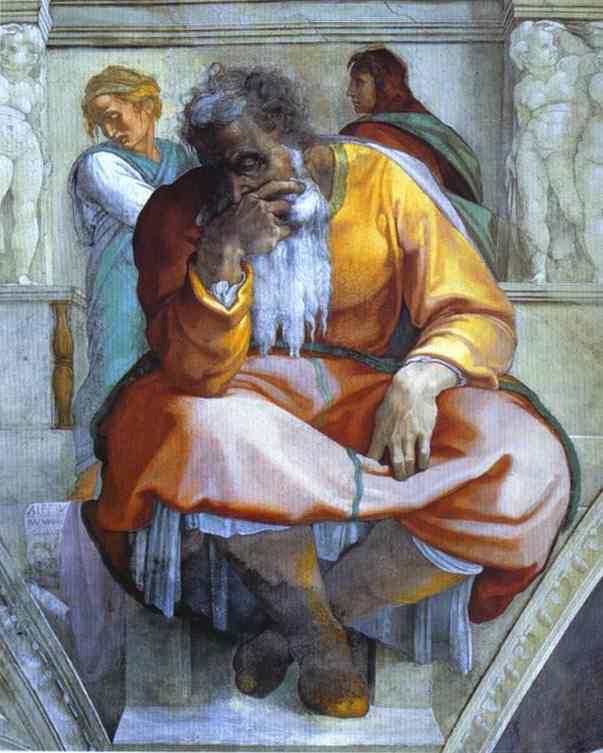
The Passion of the Prophets

From around 740 to 520 BCE we find the ministry of the Hebrew prophets (with the possible exception of Malachi). It was a time of significant social crisis, cultural decay, and political instability. The small farmers were the backbone of the Israelite society but were consistently losing their farms to large landowners. Heavy taxes and debtor laws allowed the wealthy elites to exercise foreclosures and take the lands from small farm owners, forcing them to become indentured servants. Instead of protecting them the Kings justified the practice. He profited from the creation of growing estates. What was once a fairly equitable society committed to the Law of Moses had become a society dominated by a small class of large landowners and business people whose power outstretched the reach of the small farmers and common folk. ⁣

In come the prophets as statesmen, patriots, poets, and moralists filled with passion for Yahweh’s creation and justice. Each one set out to lovingly confront society and the systems of power. Animated by their engagement with divine love, they found the courage to condemn oppression, call out unjust systems, and invite society into a different way of imagining life in the hope they would envision an alternative future with Yahweh as King. If they could imagine it and see it, a more just and equitable society could be cultivated in light of Yahweh’s covenant. They could live in to their divine vocation to become a light unto all the nations.⁣

⁣Society didn’t listen. The commitment to their economic systems, interpretations of freedom, and blindness to nationalism was too strong, despite their claim as worshippers of Yahweh. The prophets were persecuted. The Israelite way of life was utterly destroyed.⁣

*Artwork, “The Prophet Jeremiah” by Michelangelo Buonarroti (c. 1542–1545); Oil.
Posted in Christian living, Church, Social Justice, Theology | Leave a comment

Jesus Will Be

To crown Jesus King
is to participate in the peace he brings.
To crown Jesus Lord
is to long for war no more.

He may fit “inside” our hearts,
But he will not fit inside our preferences.
He may stoop down to us in love,
But he will not comply with our politics.

He will be King, not concierge.
He will be Savior, not subordinate.
He will be Redeemer, not Republican.
He will be Day-Star, not Democrat.
He will be Liberator, not Libertarian.
He will be our mediator of a New Covenant,
Not mediator of a nationalistic commitment.
He will be our Advocate and Victor,
Not our advocate of violence.
He will be our Prince of Peace,
Not our prince of war.

Jesus is the Lamb of God that was slain,
The First-Born from the dead
Given authority over all things.

He is the head of the Church
Whose reign will never fail,
Whose love is never fickle,
And power never frail.

The Church can not betray her confession
With the witness that she brings
To a world suffering in violence.
She must crown Him Lord and King.

Crown him Lord and King.

We must crown him Lord and King.

~ a free verse poem published in this form on January 9, 2020

Posted in Poetry | 1 Comment

It Will Be Done

We were born in a system
doomed to fail
built on the back of oppression
hidden in a fairy tale

of greed-laced delusion,
seduction and confusion.
It’s easy to forget where we belong.

The promises of empire
and disordered desire,
we forget Mary’s song.

From the depths of her soul
comes a song of redemption,
of salvation and justice
for those bruised by affliction

where the powerful will go down
clinging to their clay crowns.
The clock is ticking and it will be done.

Love will drive out fear.
The Lord will not ignore the tears
and the bloodshed of daughters and sons.

~ A free verse poem written January 3, 2020

Posted in Poetry, Uncategorized | Leave a comment