Our Community Multifaith Vigil for the Tree of Life Shooting Victims

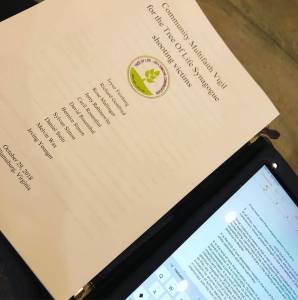
This is a message I delivered at the Community Multifaith Vigil for the Tree of Life shooting victims in Williamsburg Virginia on October 29, 2018. I am thankful for my dear friend Rabbi David Katz and the beautiful people of Temple Beth El for allowing us to share in their sorrow. You can read what Rabbi David shared with his people here.

It is an honor to stand with you on behalf of the Williamsburg Christian Church, in lament, solidarity and love. 

It has been said by a Rabbi that a religious person is one who, “holds God and man in one thought at one time, at all times, who suffers harm done to others, whose greatest passion is compassion, whose greatest strength is love and defiance of despair.” 

This is what I believe the Rabbi means. When a man or woman is compelled by the conviction that leads them to believe in a Divinely-assigned worth found within every human being, they cannot help but be moved by a passionately compassionate, empathetic love. This conviction will compel he or she to share in the suffering of others and stand in defiance to despair with courage being free from fear.  

It is the kind of love desperately needed in the face of the unmitigated evil called white supremacy and anti-semitism.

It is the kind of love that becomes life-giving in a society filled with fear and bent toward violence. It is a mysterious, Divinely-inspired act of other-worldly love that possesses a power to liberate us from misguided allegiances and misplaced hopes.  It is this kind of love that moves us beyond self-serving interests and into self-giving investment. It is this kind of love that extends gracious hospitality to all people because all are of great worth and value just as they are. It is this kind of love that drives out fear and offers an impassioned invitation for anyone to come. It is this kind of love for which we ache, especially in moments of sorrow, because it is most closely intertwined with the love of the Divine. 

A community’s commitment to this kind of love becomes a stubborn act of refusal to give in or give up.

In a society dominated by fear, indifference and violence, this kind of love is a heroic act of defiance. 

In a society seduced by power, position and privilege, this kind of love is a heroic act of resistance. 

In a society determined to push aside the weak, marginalize the vulnerable, and exclude the stranger, this kind of love is a heroic act of protest. 

Tonight, love compels us to make this confession.
We will not let fear move us to concession.
We can never rest.
Love is our protest.

We will defend the displaced,
With a bold embrace.
We will welcome the unwanted,
With a grit undaunted.

We will plead for those who suffer,
under the weight of hatred from another.
We can never rest.
Love is our protest.

Though the anger rages on,
And the arrogant seem strong,
Though denial is the school,
And many play the fool.
We will never rest.
Love will be our heroic act of protest.

Amen.


We remember the victims of Tree of Life Synagogue45013133_10161323257695508_4354522863009529856_n

Joyce Feinberg, 75
Rich Gotfried, 65
Rose Malinger, 97 
Jerry Rabinowitz, 66
Cecil Rosenthal, 59
David Rosenthal, 54 (disabled brothers)
Bernice Simon, 84
Sylvan Simon, 86 (a married couple)
Daniel Stein, 71
Melvin Wax, 88
Irving Youngner, 69


As a nation where this kind of white supremacist hatred endures, we also remember Maurice Stallard, 69, Vickie Lee Jones, 67, from Jeffersontown, Kentucky. Just two days prior to the Synagogue shooting, they were gunned down in a Kroger grocery store by a white male simply because they were black. According to the police the white terrorist attempted to enter First Baptist, a predominately African American Church, shortly before the shooting, but to no avail. Yet, his hatred spurred him on.

Lord, comfort the families of all these victims. Forgive us for the sins of white supremacy and anti-Semitism, and heal our nation. In your mercy and because of your stedfast love, bring justice for the oppressed and restore your Shalom to the world you love.

Posted in Uncategorized | Leave a comment

Our Fathers & Mothers

“We who formerly treasured money and possessions more than anything else now hand over everything we have to a treasury for all and share it with everyone who needs it. We who formerly hated and murdered one another now live together and share the same table. We pray for our enemies and try to win those who hate us.”
~ Justin the Martyr, early Church Father (100AD – 165AD)

“Hilarianus the [Roman] governor, who had received his judicial powers as the successor of the late proconsul Minucius Timinianus, said to me: ‘Have pity on your father’s grey head; have pity on your infant son. Offer the sacrifice for the welfare of the emperors.’
‘I will not,’ I retorted.
‘Are you a Christian?’ said Hilarianus.
And I said: ‘Yes, I am.’
Then Hilarianus passed sentence on all of us: We were condemned to the beasts, and we returned to prison in high spirits.”
~ Perpetua, a young, well-educated, noblewoman of Carthage in North Africa and early Church Mother and martyr (203AD)

Years ago when I came to a crisis of faith and my belief in the veracity of the Bible, I turned toward Church history. I wanted to look to people who lived in the time closest to the story of Jesus of Nazareth. I felt like they could offer me a clearer glimpse into what Christianity was supposed to look like, even in the midst of their own cultural, socio-political, and patriarchal reality.

I collected all the source material I could find, dating back to 33AD. It was a two year journey of singular focus and study. As I encountered the era when Christianity gained imperial power (due to Emperor Constantine’s conversion to Christianity), I saw subtle shifts in the way Christianity was understood. What had been a life-reorienting, society-blessing movement of faith grounded in practices of self-giving love and hospitality slowly morphed into a western-expansion Empire grounded in institutionalism and, at its worst moments, militarism.

I remember being sickened by the atrocities and violence committed in the name of Jesus after the Church settled into state power. I also vividly remember being convicted by the voices of dissent that called out to the Imperial Church to relinquish the nation-state agenda, repent, and take hold of God’s kingdom-agenda. These Christians were the vocal minority crying out to the Christian-majority to follow the true Christ as King rather than the co-opted Christ of the empire. In a world of western expansion and imperialism faithful Christians looked back to join the chorus of voices from the first 300 years of the Christian faith. The writings, teachings and Christian witness of the early Church fathers and mothers had their own problems, but at least they predated the discriminatory and violent acts committed by the Imperial Church.

The early Christians spoke of a very different understanding of Christianity, resulting in a peculiar way of life. Jesus’ sermon on the mount seemed to be their guiding ethic. The love of God and neighbor as commanded by King Jesus was their interpretive key for Christian living. They believed God saw something of Himself in all people and they should imitate Him by welcoming and caring for all. They also believed Christ could especially be found in the marginalized lives of the poor, the immigrant, the widow and the orphan. They were compelled to resist all forms of false teaching, fear-driven hatred, violence and injustice. Not only that, as much as they loved their country and countrymen, they refused to place their love of country above their love of Christ and neighbor, which included their nation’s enemies. They knew that even in all her glory, the kingdom of Rome would never outlast the Kingdom of God. Only one politic could govern their lives. They didn’t split allegiances.

The early Church fathers and mothers had their short-sighted pitfalls, just like the best among us, but one of the most beautiful things about the Christian faith is that God works in and through imperfect humans to bring liberating hope. Sadly, once Christianity married the Empire such imperfections led to more and more movements of dehumanization and death.

It’s almost like the early Church fathers and mothers knew that if the Church ever got entangled in nation-state power, the faithful witness of God’s kingdom would be harmed. Or maybe they knew enough about the human condition and the power of Empire politics that they were compelled to cling tightly to Christ as King.

Either way, one thing seems clear to me. The early Church fathers and mothers were unwaveringly committed to the peasant Nazarene as the promised Messianic King who emptied Himself of His divine rights, position, privileges and power for the good of all people. They kept before them Christ’s submission to state execution by the hands of his own people in collusion with the Empire so all people in all nations could know the liberating love of God. They held on to the teachings of the apostles who taught that love does no wrong to a neighbor and blesses enemies because love casts out fear. They understood that when fear enters into the human heart it seduces us to grasp for power and control and casts out love. And when love is cast out, death is all society has left. It’s especially true when the Church becomes entangled with the power of the nation-state.

We still have a lot to learn.

“To those who ask us whence we have come or whom we have for a leader, we say that we have come in accordance with the counsels of Jesus to cut down our warlike and arrogant swords of argument into ploughshares, and we convert into sickles the spears we formerly used in fighting. For we no longer take ‘sword against a nation,’ nor do we learn ‘any more to make war,’ having become sons of peace for the sake of Jesus, who is our leader, instead of following the ancestral customs in which we were strangers to the covenants.”
~ Origen, early Church Father (185AD – 254AD)

Posted in Uncategorized | 1 Comment

A Confession

I have a confession. I find myself weary of seeing all these images of crying children and parents, and reading so much on what is happening to the refugees and asylum seeking families on our borders. I remember that I felt this way about Syria. But then I remember the faces and they turn my weary sympathy into wanting-empathy.

I am reminded of how privileged I am to sit on my couch and look at my screen and say, “I think I will just ignore it today. Enough already! I can’t take anymore.” It is then that I am forced to imagine what it is like for them. They can’t ignore what they are living. Everyday day that dawns I imagine they say, “Enough already! I can’t take anymore.” Yet they must. They don’t have a choice.

But I do. I can choose to look away because it is too hard to remember. I can choose to look away so my life won’t continue to be disrupted by their suffering. I can even choose willful blindness and explain the situation away as too complicated, and just get on with my life. Or I can choose to look. I can choose, as far removed as I am from them and as unimaginable as their situation is to me, to stay with them. I feel like I have to keep their faces before me just like their faces are kept before my God. If I don’t, my empathy may turn to sympathy and my sadness to cynicism. Besides, if it were happening to me I don’t think I would want you to forget.

I just don’t think I can let that happen because I have made a much deeper confession, that even in a world filled with suffering and sorrow Jesus is still Lord and at work in the world. And I have come to believe that being a Christian isn’t about having good ideas, but about having open eyes to see the image of God in others. From there the weight that burdens my heart can bring me to my knees in lament and prayer. By God’s grace and strength, maybe then I will find a way to put my hands and feet to my prayers alongside others who are doing the same.

Posted in Uncategorized | Leave a comment

The Psalm of Life

I want to share a timely poem by Henry Wadsworth Longfellow, my favorite one he penned. Read it slowly and see it. I hope it stirs your heart just a little.

What the heart of the young man said to the psalmist

Tell me not, in mournful numbers,
Life is but an empty dream!– For the soul is dead that slumbers,
And things are not what they seem.

Life is real! Life is earnest!
And the grave is not its goal;
Dust thou art, to dust returnest,
Was not spoken of the soul.

Not enjoyment, and not sorrow,
Is our destined end or way;
But to act, that each to-morrow
Find us farther than to-day.

Art is long, and Time is fleeting,
And our hearts, though stout and brave,
Still, like muffled drums, are beating
Funeral marches to the grave.

In the world’s broad field of battle,
In the bivouac of Life,
Be not like dumb, driven cattle!
Be a hero in the strife!

Trust no future, howe’er pleasant!
Let the dead Past bury its dead!
Act,–act in the living present!
Heart within, and God o’erhead!

Lives of great men all remind us
We can make our lives sublime,
And departing, leave behind us
Footprints on the sands of time;

Footprints, that perhaps another,
Sailing o’er life’s solemn main,
A forlorn and shipwrecked brother,
Seeing, shall take heart again.

Let us, then, be up and doing,
With a heart for any fate;
Still achieving, still pursuing,
Learn to labor and to wait.

Posted in Uncategorized | 1 Comment

Our Dramatic God

God has a penchant for the dramatic.

Take a look at the prophets. They often stood in public squares and crowded streets and shared God’s message to his people as poet-preachers, storytellers and singers. Other times they enacted God’s word in a kind of “street theater,” performing signs and visions with their bodies, using ordinary objects as props and ordinary places as their stage.

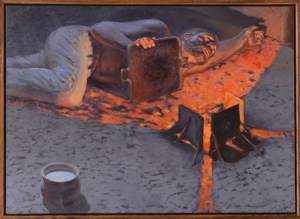
Remember when Isaiah was commanded to walk naked and barefoot for three years to communicate how the king of Assyria will “lead away the Egyptians as captives and the Ethiopians as exiles, both the young and the old, naked and barefoot, with buttocks uncovered, to the shame of Egypt” (Isa. 20:2-4)? Jeremiah was commanded to bury his newly purchased underwear in a rocky place at the Euphrates and return to dig up his now ruined underwear several days later to symbolize the ruined pride of Judah and Jerusalem (Jer. 13). Then there is Ezekiel and his many award worthy performances. One time he ate a scroll (no dipping sauce) to symbolize God’s word being put in his mouth and then bound himself with ropes inside his house to symbolize that he may speak to the people only when God wants him to speak (Ezek. 3). Another time he dramatized the fall of Jerusalem with a multi-day street theatrical performance playing war with bricks and other props followed by many weeks of lying down in the street using other props to communicate God’s word, including his own hair, fecal matter and bread (Ezek. 4-5). Yikes!

You may already know this, but just over one-third of the Bible is poetry. Perhaps God feels it’s necessary to communicate His vision of life to us with language structured differently from ordinary prose. Sometimes it takes language in the form of story, poetry or embodied performance to expand the imagination in order to see new possibilities. 

Michael Buesking Ezekiel Laying Siege to Jerusalem

“Ezekiel Laying Siege to Jerusalem” Artist, Michael Buesking

Dramatic changes in one’s way of life often necessitates a dramatic change one’s a way of thinking. It requires an entirely different imagination. God’s people lacked imagination.

As society grew more committed to empire politics and violence, the Jews traded in story-driven covenant loyalty for data-driven logic weighed down in politically spun facts and sorted out feelings through political logic. They could not imagine a society different from that of the other nations. They could not imagine how commerce could be fair and good for all. They could not imagine equitable economic practices capable of promoting human flourishing. They could not imagine a society without a permanent underclass, where the widow, the poor, the immigrant and the orphan were valued. Israel forgot her own story, a history that speaks of transformation, liberation, healing, and newness, all coming about in the form of miracles wielded by a God who can do the impossible. As a result they failed to keep their imaginations big enough to envision the kind of life Yahweh offered, a life of truth, goodness and beauty culminating in righteousness, mercy and compassion.

God’s people have always had a lack-of-imagination problem. We still do.

Sometimes sermons communicated in ordinary prose or written on parchment are not enough. Sometimes it takes truth expressed in the form of drama, dance, music, poetry, drawing and sculpting to stir our hearts and open our minds to life-affirming possibilities. Throughout history God as the Creator has embodied his truth and goodness through the creative arts in redemptive ways as his form of protest in a society numb to violence and injustice. The creative arts become redemptive arts when they are embraced as a medium by which God can display the beauty of his love and justice in love-less and unjust societies. He did it through his people and for his people, then. I believe he wants to do it now.

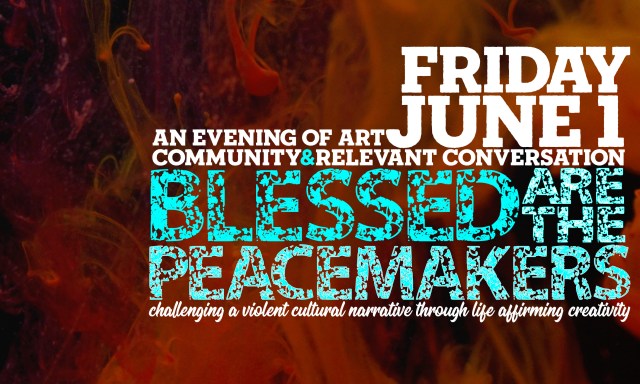
This is why I am excited about WCC’s arts initiative and the “Blessed Are the Peacemakers” event this Friday evening.

I know we don’t all agree on how the violence and injustices should be handled, but we can all agree that the violence and injustice must be dealt with. In light of the great tradition of the prophets, is it possible that redemptive art can awaken us to a different imagination? Can creativity, beauty and community investment be the means by which the beauty of Christ is displayed? We need to come together to imagine ways we can put hands and feet to our “prayers and thoughts” so that new possibilities will break open in our nation. We know where the Church’s preachers, teachers and evangelists can be found, but where are the artists, poets and prophets?

Let’s come together and ask the hard questions. Let’s wrestle with potential solutions that are capable of bringing the claims of our faith to bear. Let’s imagine ways we can embody our confession and proclamation through practices of self-giving, faithful presence, and life-affirming creativity.

Digital Graphic (Public)

Posted in Uncategorized | 1 Comment