
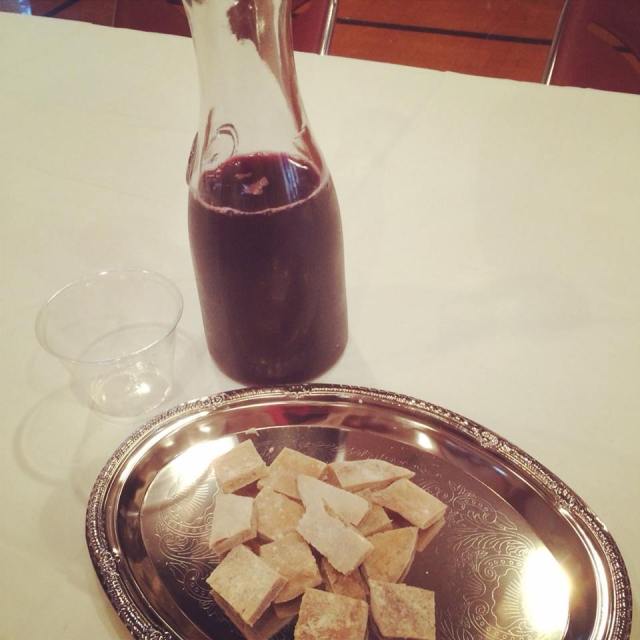
 If this election season has accomplished anything, it has been the disordering of many relationships. Political ideologies mixed in with a commitment to a particular set of values, virtues or fears have put friend against friend. Sadly, the Church is no exception. There are many reasons for this, for which I will not attempt to unpack here. I am only interested in the way forward because November 9th is coming. Jesus will still be Lord, neighbors will still be present to love, and the Church will still be called by God participate in his work in the world by the Spirit. If the church is stay oriented to this invitation, we will need to reorder what has become (sadly) disordered–lives, relationships, ethics, politics; we will need a renewed invitation to the eucharistic Table.¹
In my church family, we have a eucharistic orientation to our weekly worship gathering, which moves us directly from the proclamation of the Word (sermon, teaching or open conversation) to the Table. We no longer offer an “altar call” (in my tradition we call this an “invitation,” usually to repentance and baptism). We invite people to tend to the presence of Christ among us by coming forward in two lines side-by-side to the Table. Now, I do not believe there is anything wrong with the former and I do not mean to shun or devalue different liturgical impulses. Each church has it’s tradition based upon theological commitments. But for us, it is a renewed theological (and missiological) commitment that has necessitated our shift from Word to Altar, to Word to Table (Sacrament or Eucharist).
We have found that coming together to the Lord’s table after the Word has been proclaimed reorders our lives. It calls us to submit all ideologies to the lordship of Jesus Christ. The way to guard ourselves from allowing our ideologies to overshadow the truth and cultivate eucharistic living—the way of gratefulness, hospitality, the culmination of the common life rooted in our true identity, and in preparation for mission–is our weekly practice of Word to Table.
Rehearsing the Gospel
Coming together to the Lord’s table serves as a rehearsal of the gospel as we practice receiving the welcome of Christ. Through the Word we reflect upon the dramatic unfolding of God’s redemptive work in and for the world. At the Table we prayerfully submit to it’s authority and participate in what God has done for the sake of the world as we discern his presence among us. The Lord’s table becomes the embodiment of submission and participation both to and with Jesus as Lord, and to and with one another as his Church. The inseparability of Word to Eucharist reorders our lives and reinforces our identity in the presence of Christ: we are the children of God delivered from the reign of sin and death and transferred into the reign of grace as citizens of his kingdom.
Cultivating a Grateful Community
As we come forward together to receive the bread and wine with an attitude of faith and self-examination, we remember and proclaim the death of Christ, receive nourishment for our souls, and signify our unity with Christ and one another. At the Lord’s table we remember our need and God’s provision, which becomes our training for grateful living. All we are and have is a gift of grace, no matter how mundane or seemingly ordinary. God uses the ordinariness of the bread and wine to help us remember the nourishment he provides to us in Christ. Just as eating and drinking is basic to life and captivates all our senses, the presence of Christ in the midst of his people leads to human flourishing and captivates all aspects of life. Our hope is to leave the Table with gratefulness as the disposition of our lives so we may resist the disposition of selfishness.
Cultivating a Common Life in Community
At the Lord’s table we acknowledge both our need for one another and common belonging, which becomes our training for cultivating a common life. In the Eucharist we remember the announcement that all wrongs have been forgiven by God, so we must become a forgiving community. In the Eucharist we remember that God shares all he has in Christ, so we must be willing to share all we have with one another. In the Eucharist we remember that the walls of hostility which once separated us from God and one another have been torn down, so we must become a peace-making, reconciling community. At the Lord’s table the ideologies and antagonisms that drive wedges between us are placed in submission to the presence Christ as he draws us toward each other. The fear-driven, death-dealing narratives of party-politics and society’s “-isms” at work among us are exposed and placed in submission to the lordship of Christ. The permission we give ourselves to choose who sits at our daily tables is called into question as we acknowledge that we do not get to choose who sits at the Lord’s table. As our gracious Host, the Lord alone determines who is welcomed and he has made it clear that any one can come.
The Table as Training for Hospitality and Homemaking in a Inhospitable Society of Displacement
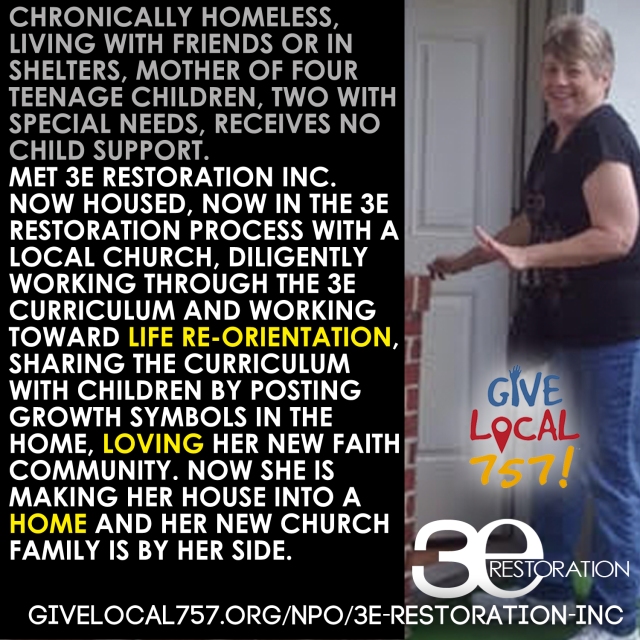
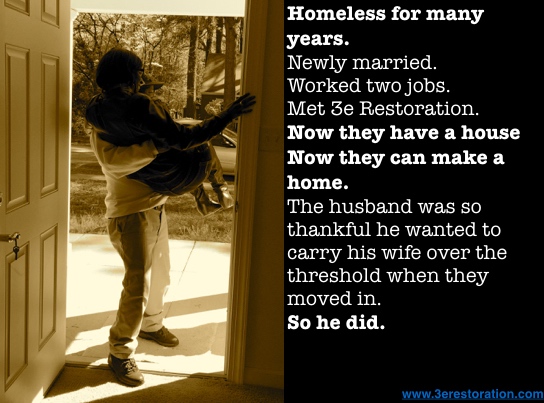
Therefore, the Table becomes our training for hospitality in a inhospitable society. The same kind of welcome extended to us by Christ becomes the same kind of welcome we extend to others. In the bread and wine we remember that we have made our home with God and are summoned to become homemakers in society. We have received his hospitality and are summoned to live hospitably before the world. If we understand the Eucharist this way, our personal tables become an extension of the Lord’s table. Our lunch tables become extensions of the Lord’s table. Our cubicles become extensions of the Lord’s table, because we remember that we are to be as welcoming to the person who cleans our trash as to the person who signs our paychecks. The Table forms us a people, a family, on mission with God in our society.
- Eucharist means thanksgiving [eucharistēsas]. The word is found in 1 Corinthians 11:23-26. Scholars believe it is used by Paul to point back to the Last Supper in Mark 14:22-25, Matthew 26:26-29, Luke 22:14-20. I tend to agree.
 Perhaps this is why Jesus calls us to welcome the reign of God into our lives like little children. I believe he is inviting his people to believe foolishly in a world of new possibilities. He invites us to envision a world where we believe resurrection is possible because we believe God is actively at work in, between and among us. He invites us to believe that the power of self-giving love can turn enemies into friends, that the excluded can be included and neighbors cared for because true compassion can move us toward mutual understanding in spite of disagreement. The crucified and risen King Jesus invites us to believe that the last can be first, the meek can inherit the earth, and self-giving love always ultimately wins. But to believe any of it, to embrace any of the Lord’s description of this kingdom that is and is to come, we must shake off our cynicism and choose to believe again.
 Long Way Here